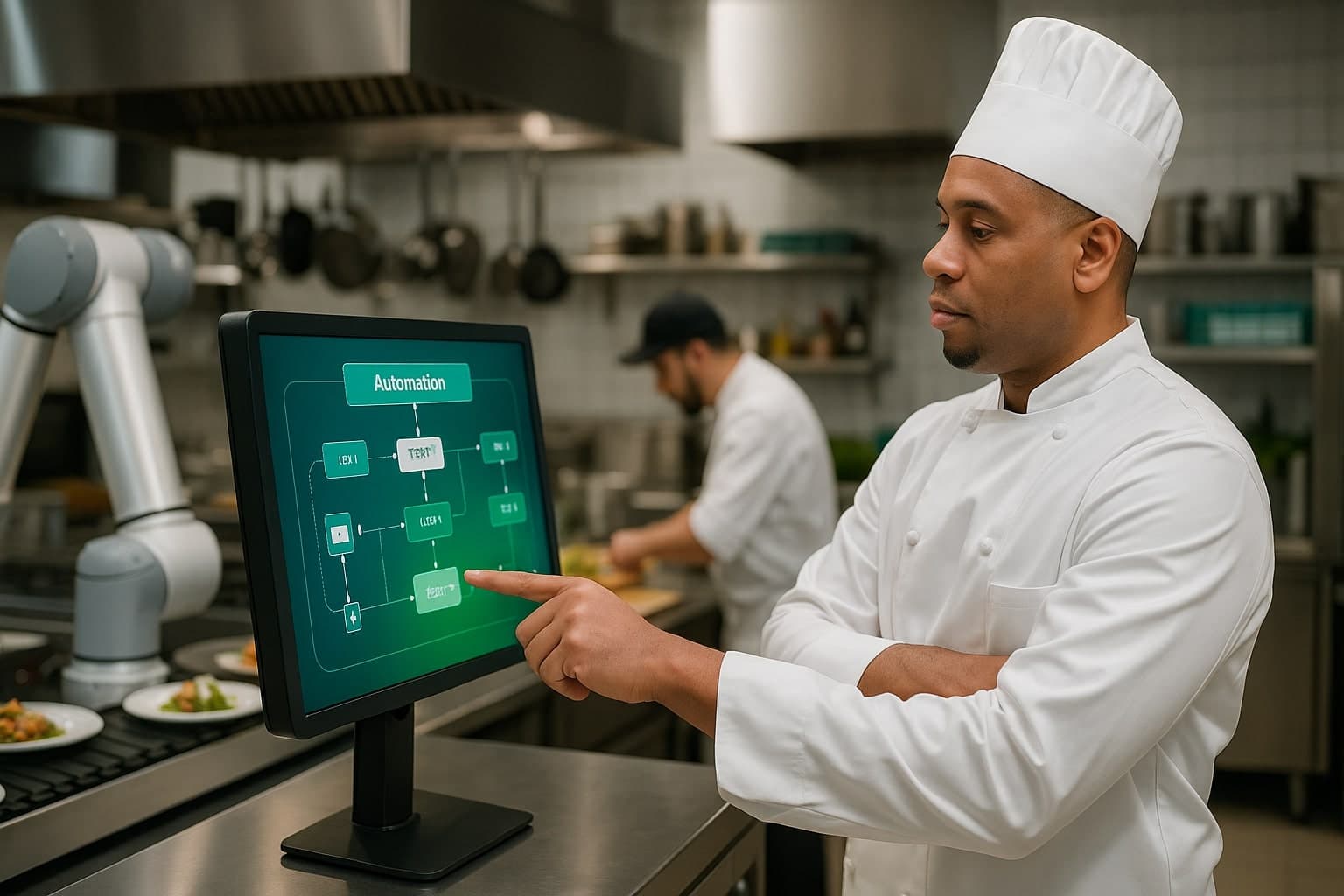

At volume, planning stops being preparation for the work and becomes the work. Scale does not reward heroics - it rewards production planning, explicit coordination, standard timings, single-source inventory visibility, and defined handoffs. Every one of those is a system, not a personality trait.
At 8,000 meals per day, you can't wing it. Scale forces systematic thinking. Everything that works informally at 50 meals falls apart at 8,000. Here's what that teaches you about operations - and why I think a kitchen is the best training ground for running any multi-site business.
Production Planning
You can't start without a detailed plan: how many covers, what mix, when each item needs prep. You're working from forecasts and historical patterns. Back-scheduling so nothing is short or over. Everyone aligned on one plan, visible to all.
At scale, planning isn't preparation for the work. Planning is the work. The operation just executes the plan.
Coordination
Multiple lines, sites, handoffs - ad hoc coordination breaks. You must make coordination explicit: who triggers production, who notifies whom, confirmation required. A single place for status visibility instead of five spreadsheets and three group chats.
When it falls apart, it's almost never because people don't care. It's because coordination was left to assumption instead of system.
Timing
Every step has a window. Too early spoils quality, too late backs up service. Timing is the difference between smooth service and meltdown. Build buffers where they matter, remove slack where they don't.
You need standard times, clear sequences, and visibility when you're off track. Not a general sense of 'we should be moving faster' - specific, measurable, flagged.
Inventory Visibility
You can't walk the cooler and know what you have when you're running at scale. You need one source of truth: what's on hand, what's committed, what's in transit.
Without visibility: over-ordering, running out, duplicating stock. Any of these at 8,000 meals either wastes money or breaks service. Usually both.
Handoffs
Shift to shift, station to station, site to site - every handoff is a risk. You can't afford 'I thought they did it' at 8,000 meals. Handoffs must be defined: what passes, to whom, how confirmed. Built into the system, not left to memory.
Standardization Is What Makes It Repeatable
Recipes and specs exist so the same dish comes out the same way every time. Portions, temps, plating - without standards you get inconsistency and waste. In operations, standardization is your playbook: one way to do the thing, so every location and every shift runs the same.
This is the piece most growing operators skip. They hire more people and hope consistency follows. It doesn't. Consistency is manufactured by standards, then verified.
Why Kitchens Produce Good Operations Leaders
Rush hour doesn't wait. In a kitchen you learn to execute when you're busy, when something goes wrong, and when you're short-handed - not because you're heroic, but because you have a system that holds up under load. Pressure tests your design.
If you came up in a kitchen, you're not starting from zero in operations. The discipline is identical. The vocabulary changes, the principles don't. Timing becomes scheduling. Expo becomes coordination. Mise en place becomes process design.
Why I Still Build From Inside Operations
I didn't leave operations to build software. I added building to what I already do, and that distinction matters. I see the problems every day, in live service, with real consequences. ShareTable, RentRight and CaterOS all came out of friction I was personally standing in.
The tools ship because they're needed. The consulting is grounded in real work. Neither would hold up without the other.
The Takeaway
Scale doesn't tolerate heroics. It forces discipline. The same discipline applies to food service, events, property management, or any operation with volume, handoffs, and coordination load.
If your operation is growing and you're relying on people to hold it together, the system will break before they do. Build the system first.
Volume exposes every weak system you have. If yours are cracking, the failure patterns are predictable.
Why restaurants actually failThe same discipline decides whether a manager succeeds or drowns.
What makes a manager effectiveWant the same read on your own operation? A free Ops Screen maps where your systems break before volume does it for you.
See how the audit works