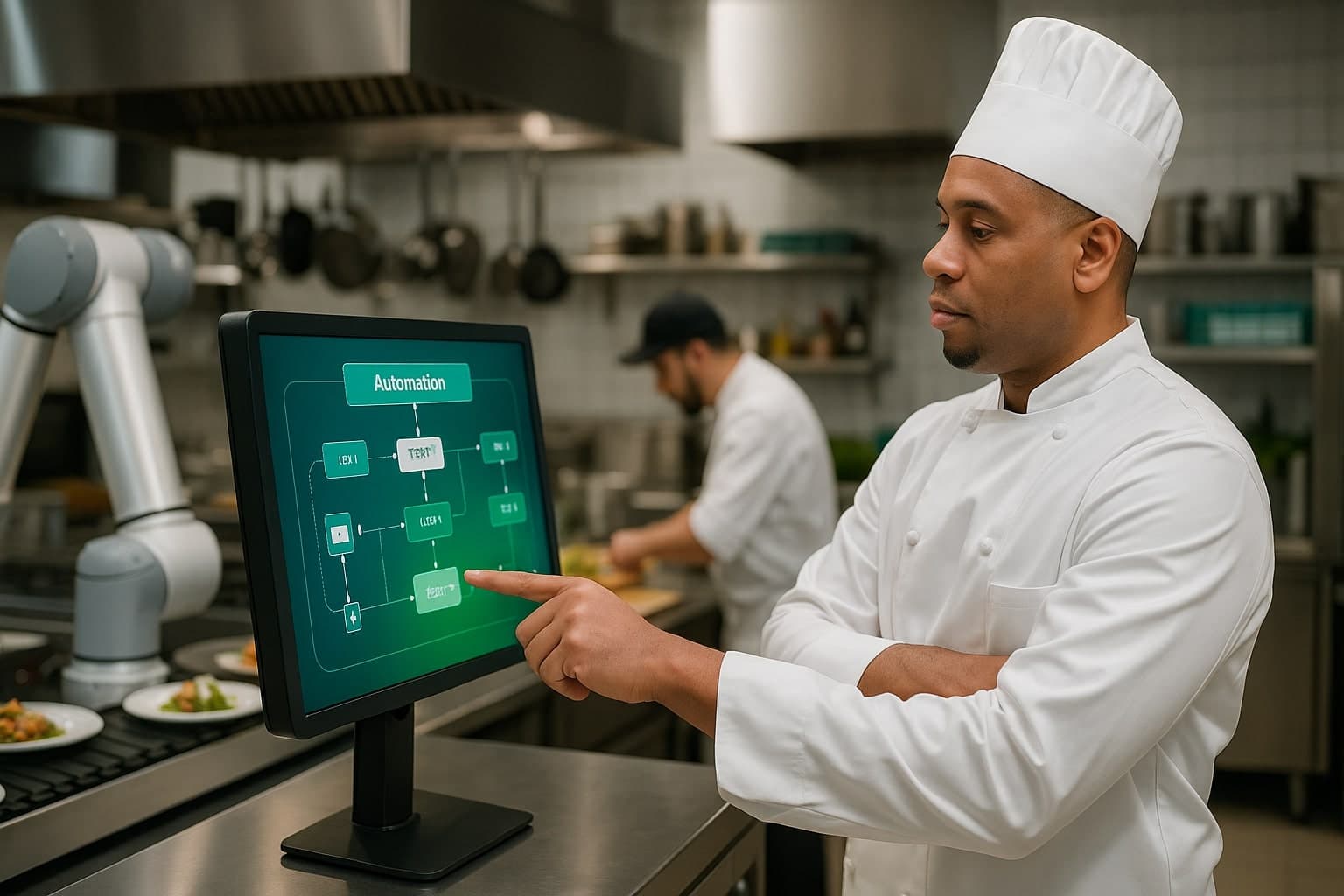

You automate the repetitive parts of inventory, the counting, par calculations, and reordering, and you keep humans on the judgment parts, receiving inspection and quality checks. Automation does not replace quality control, it frees your team's time to do it properly. The goal is fewer hours spent counting and more spent inspecting.
Operators hear automate inventory and picture a robot accepting a truck of bruised produce. That is not it. The boring, error-prone work is what you automate: tallying counts, calculating pars, cutting purchase orders. The human stays exactly where human judgment matters, at the back door checking what actually came off the truck. Done right, you get tighter numbers and better quality at the same time.
The reason this matters at scale is that inventory labor is brutally repetitive and brutally expensive across many sites. A manager hand-counting a walk-in is doing arithmetic at a manager's wage, and doing it slowly enough that the count is often stale by the time the order goes in. Multiply that across 14 buildings every week and you are paying skilled people to be slow calculators. Automation does not take their job. It takes the part of their job a calculator should have had all along, and hands the rest of their attention back to the work that actually protects margin and quality.
Separate the Counting From the Judging
Inventory is really two jobs wearing one hat. One job is arithmetic: how much do I have, how much do I need, what do I order. The other is judgment: is this product good, is the temperature right, did the spec get met. Automation is fantastic at the first and useless at the second. The mistake is treating them as one task and either automating both or neither.
- Automate counts and par math, where humans are slow and error-prone
- Automate reorder suggestions off usage and forecast, not guesswork
- Keep receiving inspection human, because no system can smell spoilage
- Keep spec verification human, because quality is a judgment call
- Keep the final accept-or-reject decision human, always
What to Automate First
Start where the time goes and the errors hide. For most operators that is the weekly count and the order. A manager hand-counting a walk-in and then guessing the order is slow and wrong twice. Automate the math and you reclaim hours and shrink the ordering errors that drive both waste and stockouts.
| Task | Automate or human | Why |
|---|---|---|
| Counting on-hand inventory | Automate | Repetitive, error-prone |
| Calculating par levels | Automate | Math, tied to usage |
| Generating purchase orders | Automate | Rules-based off pars |
| Receiving inspection | Human | Requires sensory judgment |
| Quality and spec checks | Human | Requires standards judgment |
Automation Should Buy You Quality Time
Here is the part operators miss: when you stop spending two hours counting, that time does not vanish, it moves. The best operators redirect those reclaimed hours into the receiving dock, where catching one rejected case of bad protein protects every plate that week. Automation that just cuts headcount misses the point. Automation that moves human attention to where it pays off is the win.
Across my sites, automating counts and orders cut inventory labor meaningfully per location per week, and we spent that recovered time on tighter receiving. Waste from accepting subpar product dropped because someone was finally standing at the door with the spec in hand instead of buried in a clipboard.
There is a second, quieter win in automating the count and the order: the numbers get more accurate, not just faster. A human counting a walk-in at the end of a long shift makes transcription errors, skips a shelf, and rounds when they are tired, and every one of those small mistakes feeds a slightly wrong order. The wrong order then drives either waste from over-buying or a stockout from under-buying, and both cost real money. A system doing the arithmetic does not get tired, does not skip the back shelf, and does not round to get home faster. So you reclaim the hours and you tighten the order at the same time, which is why the payback shows up in two places at once: labor saved and waste avoided.
- Automate the weekly count and par calculation first
- Automate reorder generation against those pars
- Redirect the saved hours to a real receiving inspection
- Keep a human signing off on every delivery against spec
- Review variance weekly to confirm the automation stays accurate
A Worked Example: Where the Reclaimed Hours Go
Picture a site where the manager spends two hours counting and forty-five minutes building the order every week. Automate the count and the order math and you give that manager close to three hours back. The wrong move is to congratulate yourself on the labor saving and walk away. The right move is to spend those hours where they protect the most margin. Here is the redirect that pays off.
- Stand at the receiving dock for every protein and produce delivery, spec sheet in hand
- Weigh and temperature-check the high-cost cases instead of waving the truck through
- Reject anything off-spec on the spot and document it for the vendor scorecard
- Spot-check that what was ordered matches what was invoiced and delivered
- Log the rejections so the same vendor problem does not repeat next week
One rejected case of bad protein protects every plate that case would have touched all week. That is a return no amount of faster counting could match, and it only happens because automation freed a human to stand at the door.
Run the comparison and the logic is obvious. The faster count saves you maybe two hours of labor, real money but bounded. The rejected case of bad protein saves you every plate that case would have ruined, every guest who would have sent it back, and every review that would have followed. The first is a small, certain saving. The second is an occasional but large one, and it is exactly the kind of value a clipboard-bound manager never captures because they were never at the door to catch it. This is the whole argument for the redirect: automation does not just make the cheap work faster, it relocates a person to the spot where their judgment is worth the most.
The Mistake That Lets Bad Product In
The dangerous version of inventory automation is the one that tries to automate the back door too. Some operators, chasing the labor saving, set up auto-receiving where deliveries get accepted by default and only flagged exceptions get a human look. That is exactly backwards. No system can smell spoilage, feel a soft case of tomatoes, or judge whether the protein hit temperature in transit. The accept-or-reject decision is the single most quality-critical moment in the supply chain, and it must stay human, every delivery, no exceptions. Automate everything up to the dock. Never automate the dock itself.
See what automating the counting and ordering is actually worth across your locations.
Calculate your ROIHow to Know the Automation Is Working
Automation you do not check is just a faster way to be wrong. Watch a short list of signals to confirm the system is tracking reality and your reclaimed time is landing where it should.
- Variance between theoretical and actual usage stays small and stable
- Inventory labor hours per site drop and stay down
- Receiving rejections go up at first, then settle as vendors tighten
- Stockouts and emergency runs fall as par-based ordering takes hold
- Waste from accepting subpar product trends down
The Bottom Line
Automating inventory does not mean surrendering quality control, it means defending it. Hand the arithmetic to a system and keep the judgment with your people, then move the reclaimed time to the receiving dock where it protects every plate. Start by automating your weekly count and spending the saved hour at the back door. Systems handle the repetition so your people can handle what matters.