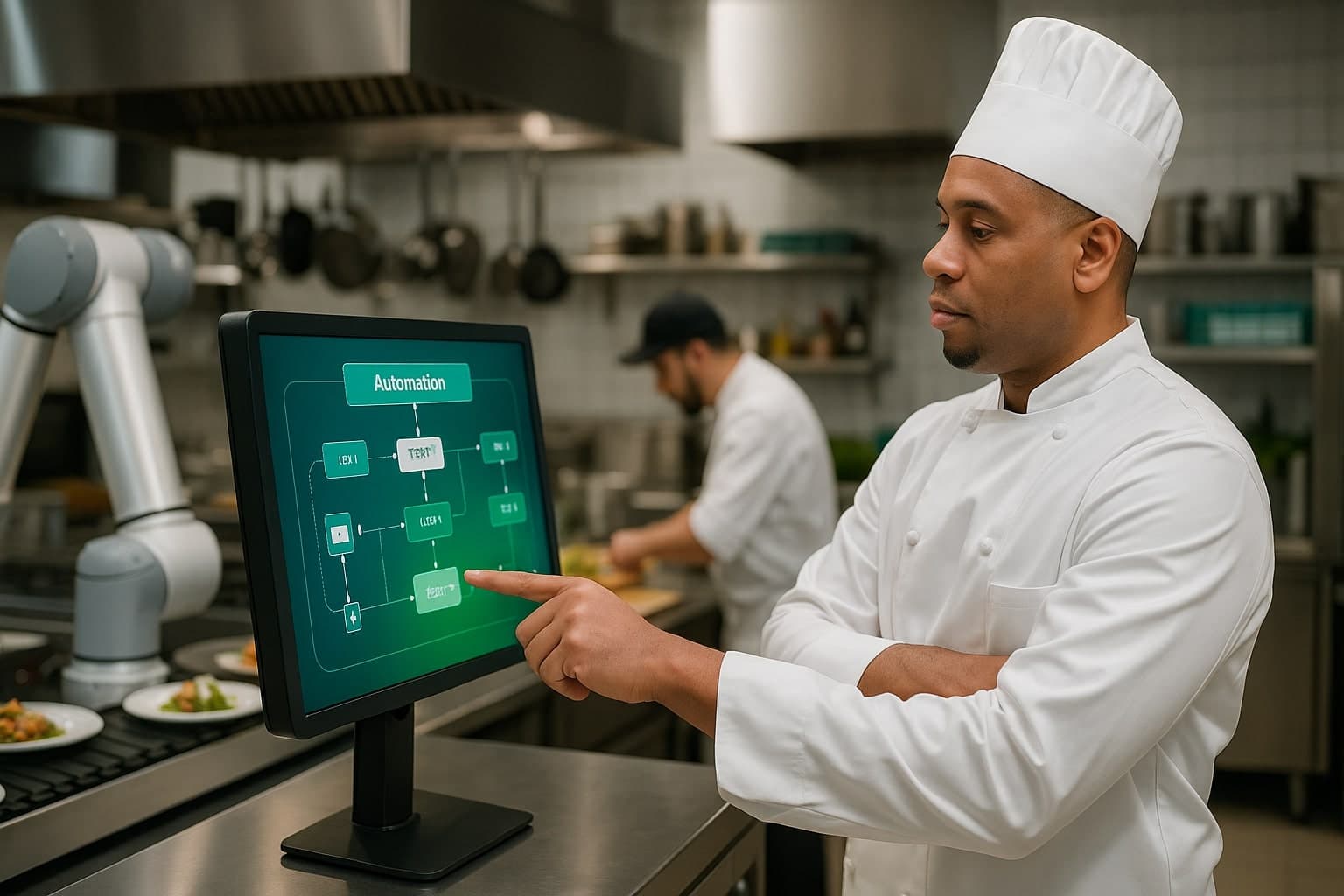

Caterers handle large orders by locking the details early and making every handoff explicit: confirmed headcount, a timed production schedule, a staffing plan, and a single source of truth everyone reads from. Chaos on big events is almost never a cooking problem, it is a coordination problem where one person knew something the rest of the team did not.
I have plated 8,000 meals in a day. The day it goes wrong is never the day the food is hard. It is the day the headcount changed and three people were working off three different numbers. The cooking is a solved problem the moment your recipes are scaled and your team is competent. The unsolved problem, every single time, is making sure the right information reaches the right hands at the right minute.
Chaos Is a Handoff Problem, Not a Volume Problem
A 400-guest event is not harder to cook than a 40-guest event, it is harder to coordinate. The risk multiplies at every point where information passes between people: sales to kitchen, kitchen to delivery, delivery to on-site lead. Each undocumented handoff is a place the event can break.
- Lock headcount and a change cutoff date in the contract
- Build a timed production schedule working backward from service
- Assign a single on-site lead with final authority
- Put every detail in one record the whole team reads
- Confirm delivery windows and access the day before
Count the handoffs on a typical large event and you understand why they fail. The client tells the sales rep. The rep tells the kitchen. The kitchen tells the prep team. The prep team hands to the line. The line hands to logistics. Logistics hands to the on-site lead. The on-site lead directs the servers. That is seven handoffs minimum, and information degrades at every one, like a game of telephone where the stakes are a $20,000 event. The job is not to be heroic at each handoff. The job is to remove handoffs by making everyone read from the same record.
This is why throwing more people at a large event often makes it worse, not better. Every additional person is another handoff, another mouth in the telephone chain, another place a number can mutate. A 400-guest event run by a tight crew of eight who all read the same record will beat the same event run by fifteen people coordinating through scattered texts every time. Coordination quality, not headcount, is what determines whether a big event is calm. Add staff only where the plan needs hands, and make sure every one of those hands is pointed at the same source of truth before they start.
Work Backward From Service Time
The production schedule is your spine. Start at service time and count backward through plating, transport, final cook, prep, and load. A 300-guest plated dinner at 7 pm is not a 5 pm kitchen, it is a 6 am kitchen. Here is a typical backward timeline.
| Time before service | Task | Owner |
|---|---|---|
| 48 hours | Final headcount locked | Sales lead |
| 24 hours | Prep list and pull sheet built | Kitchen lead |
| 6 hours | Bulk prep and cook | Kitchen team |
| 2 hours | Load and transport | Logistics |
| 1 hour | On-site setup | On-site lead |
The discipline that makes this work is naming an owner for every line, not just a time. A schedule with times but no owners is a wish list, because when 24 hours out arrives and the pull sheet is not built, there is nobody whose specific job it was. Notice the table never leaves a task unowned. The sales lead owns the headcount lock. The kitchen lead owns the pull sheet. When something slips, you know exactly whose phone to call, which is half the battle on a large event.
A Step-by-Step for Locking a Big Event
When a large booking comes in, run it through the same sequence every time so nothing depends on memory under pressure.
- Confirm the headcount and write the change cutoff date into the contract
- Build the backward production schedule from service time and assign every owner
- Generate the pull sheet and order against confirmed numbers, not estimates
- Build the staffing plan from event size and name the single on-site lead
- Confirm delivery window, dock access, and on-site power the day before
- Hold a five-minute pre-shift brief so every owner reads the same plan
One Source of Truth Beats Ten Texts
The worst large events I have seen ran on a group text and a printout that was already wrong. When the headcount, the menu, the staffing plan, and the timeline live in one shared record, a change in one place updates the whole picture. That is the entire reason coordination software exists. It is not about features, it is about everyone reading the same number.
The group text feels like coordination because it is busy, but it is the opposite. Information scrolls away. The headcount that was right at 9 am is buried under 40 messages by noon, and the new server who joins the thread at 2 pm scrolls up, finds the old number first, and preps to it. A shared record has no scroll. There is one headcount, and it is the current one, and everyone who opens the record sees the same thing whether they joined the project this morning or three weeks ago.
The Pre-Shift Brief Is Cheap Insurance
The single highest-leverage habit on a large event costs five minutes. Before the team scatters to their stations, gather everyone and walk the plan out loud: the headcount, the service time, the menu order, who owns what, and the two or three things most likely to go wrong today. People retain a number they hear and repeat far better than one they skimmed on a printout. The brief also surfaces the gap you missed, because someone always asks the question that reveals the assumption nobody checked. Skipping the brief to save five minutes is how you lose an hour to a confusion that a single sentence would have prevented.
A good brief hits the same beats every time so it becomes muscle memory rather than a speech you improvise.
- State the final headcount and have the on-site lead repeat it back
- Walk the service timeline from arrival to the last course
- Name who owns the line, the floor, and the breakdown
- Call out the two or three highest-risk moments for today
- Confirm the one person every question routes to when something changes
Build the Buffer Into the Schedule
Large events do not fail because something went wrong, they fail because something went wrong and there was no slack to absorb it. The truck hits traffic, the venue dock is occupied, the kitchen runs ten minutes behind on the protein. Each is survivable alone. Stack them onto a schedule with zero buffer and they cascade into a late service. Build deliberate slack into the backward timeline, particularly around transport and final cook, the two legs most likely to slip. A schedule that arrives 45 minutes before it strictly needs to is not wasted time. It is the difference between absorbing a problem quietly and apologizing to a client in front of their guests.
How CaterOS Keeps Big Events Calm
CaterOS ties the headcount, menu, inventory, staffing, and timeline to one event record. When a client bumps a 250 order to 300, the food order, the staffing plan, and the invoice all reflect it at once, so the kitchen and the on-site lead are never working off a stale number. That single source is what keeps a large event boring, which is exactly what you want.
See how one shared event record keeps big orders out of chaos.
See CaterOSThe Bottom Line
Large orders stay calm when details are locked early, handoffs are explicit, and everyone reads from one source of truth. The cooking is the easy part. The coordination is what separates a clean 400-guest event from a disaster. Start by writing a backward production schedule for your next big booking.